The 12 Most Valuable Yu-Gi-Oh! Cards in 2026
From 2002 Tournament Pack grails to 2024 Quarter Century chase cards — the twelve single cards with the highest documented sales in the past 24 months. Ranked, with print-run context.
YuScan app · April 29, 2026
Yu-Gi-Oh! has one of the strangest value curves in trading cards. Unlike Magic or Pokémon, where rarity and set scarcity do most of the heavy lifting, Yu-Gi-Oh! grail prices are driven by three specific variables: the print run of the 2002–2003 English launch, the gap between 1st Edition and Unlimited on early-era cards, and the speculative market for modern Quarter Century Secret Rares out of Japan.
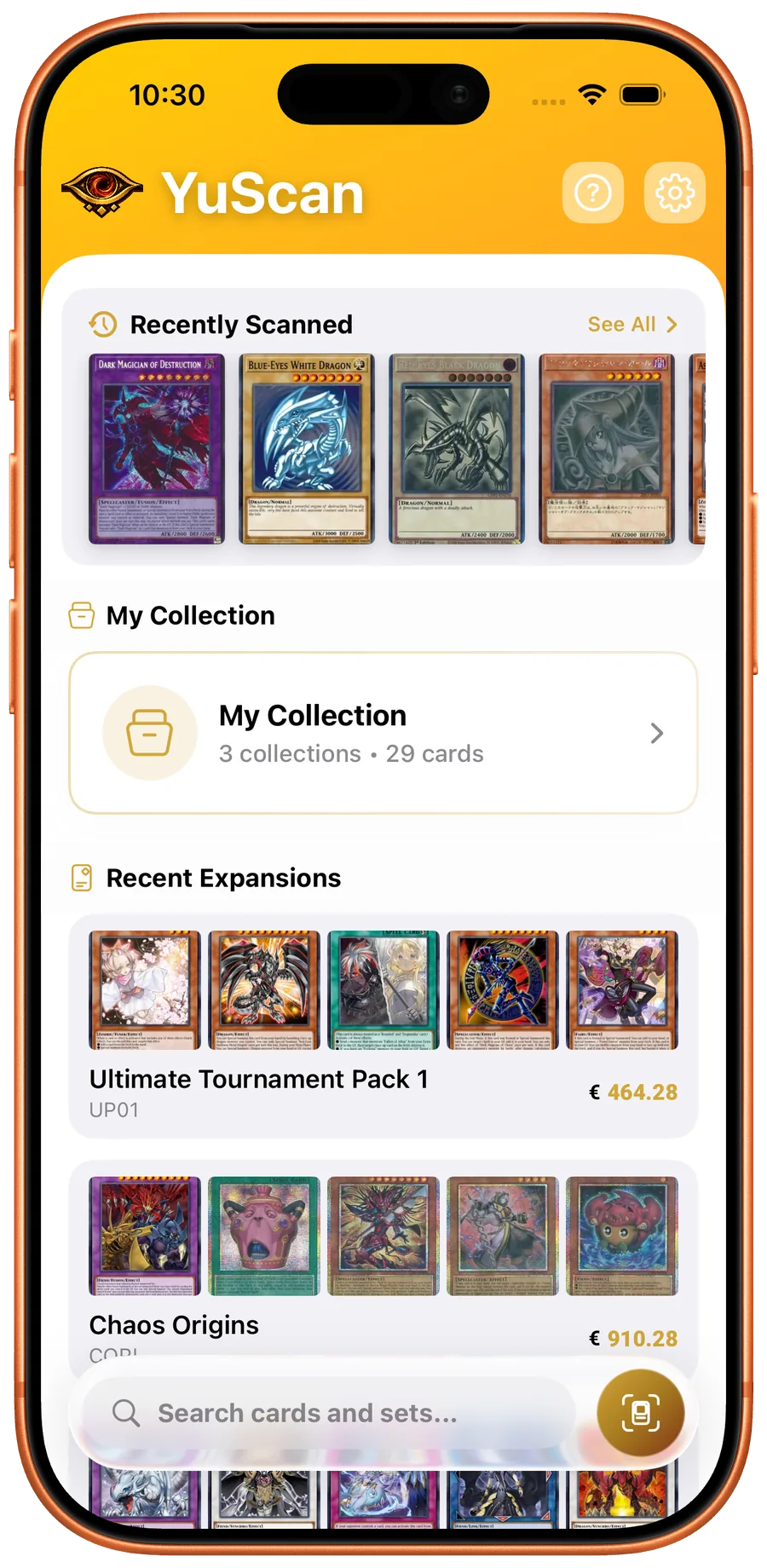
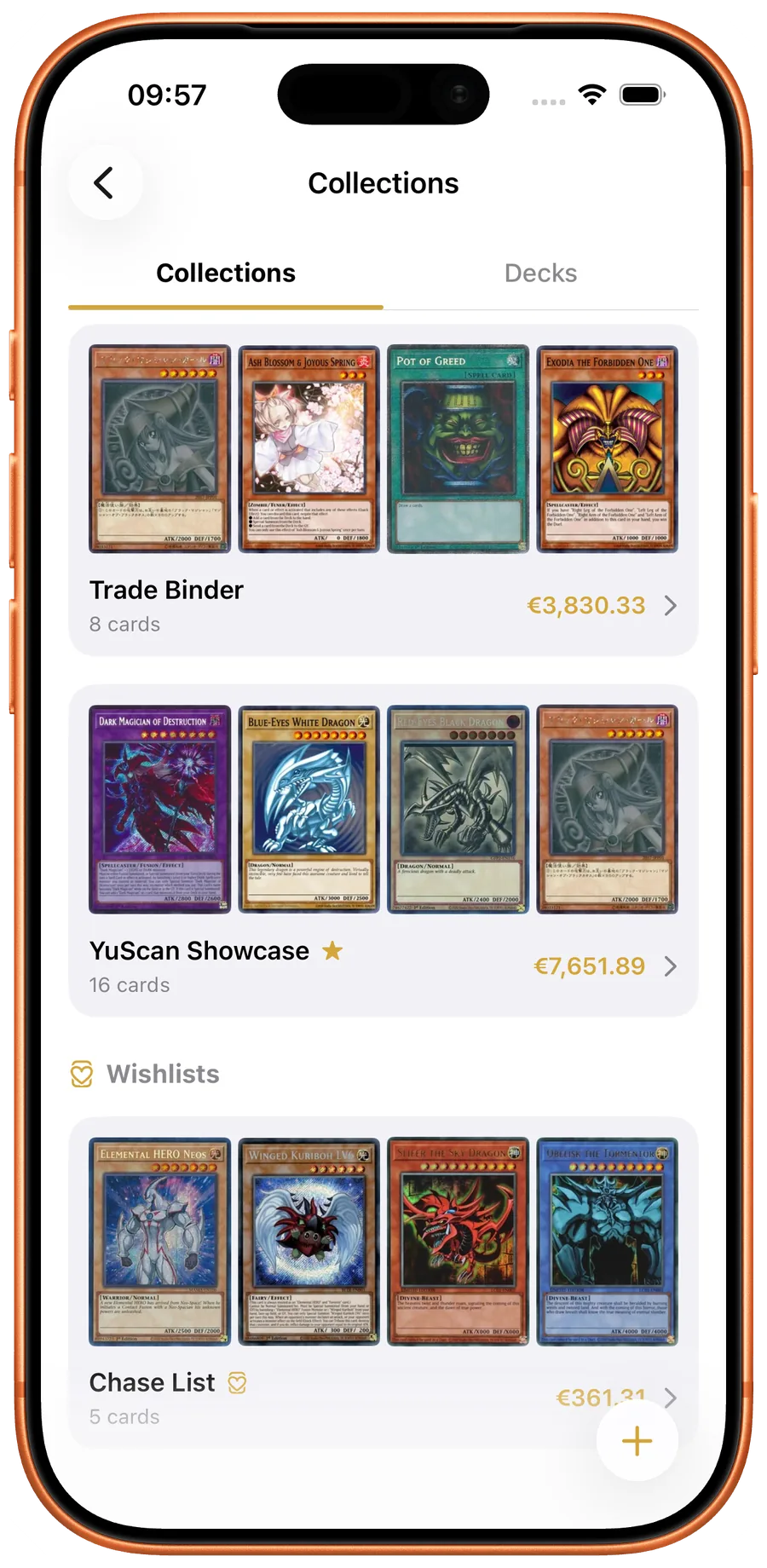
The twelve cards below all have verified sales above $2,000 in the past twenty-four months. Most of them look identical to cards worth fifty cents — the value lives in print-run codes most players never check. This is the problem that YuScan’s per-printing price tracking was built to solve. The same card name can mean a $1 card or a $15,000 card depending on six characters of set code.
The ranking
Pot of Greed
The grail of grails — a banned card worth a house down payment
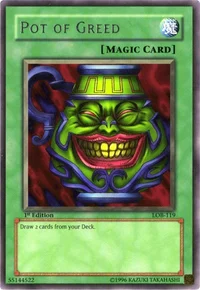
Pot of Greed in 1st Edition Starter Deck Kaiba form is the most discussed grail in the game. Konami banned the card in 2007 — it has never left the Forbidden list since. A PSA 10 1st Edition from the 2002 North American launch has traded privately for figures above $100,000 on multiple occasions, with the upper bound of reliable quoted sales reaching the mid-six-figures. The card exists in many later reprints for pennies. The one that matters is SDK-052, 1st Edition, PSA 10.
What makes it #1 is the combination: a card every Yu-Gi-Oh! player recognizes on sight, banned from competitive play for nearly two decades, printed in the smallest 1st Edition run of any English starter. The scarcity multiplies the nostalgia.
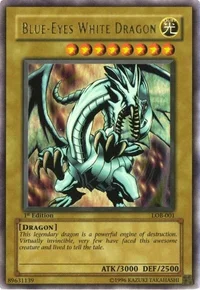
Blue-Eyes White Dragon
Blue-Eyes White Dragon — LOB-001, where it all began
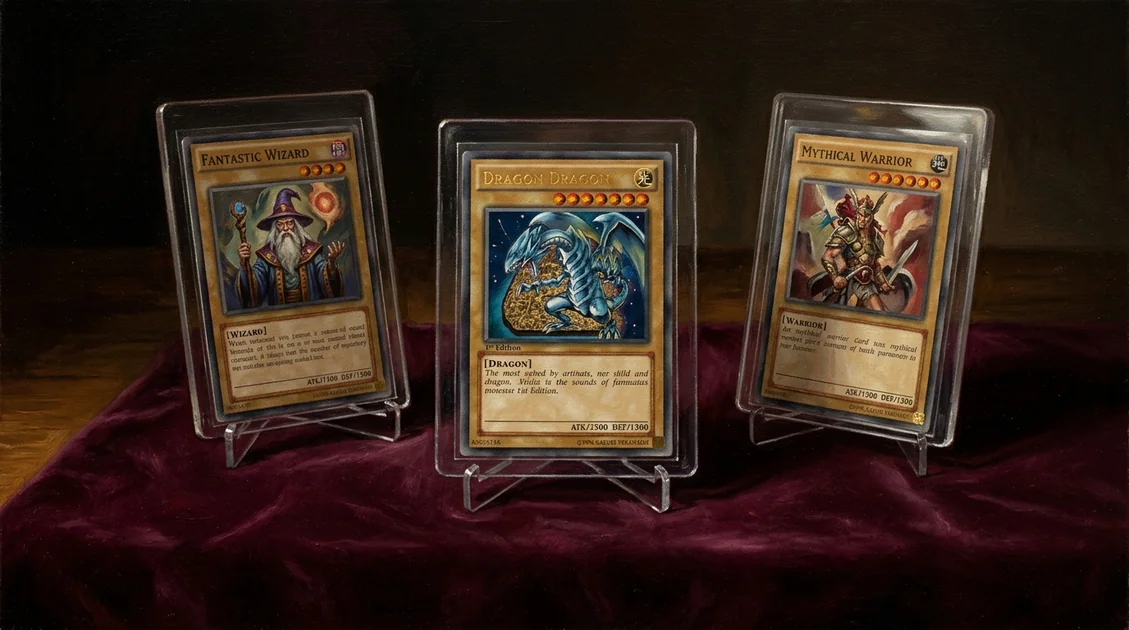
Blue-Eyes White Dragon from Legend of Blue Eyes White Dragon, 1st Edition, Ultra Rare, has a PSA 10 sales floor that sits well above most Yu-Gi-Oh! collectors’ entire collections. The 2002 LOB print run was small, the card is the franchise’s iconic image, and the population of PSA 10s is under 100 worldwide. Auction sales above $80,000 have been recorded multiple times in the last two years.
The key identifier is the LOB-001 set code, the 1st Edition stamp, and the original “Legend of Blue Eyes White Dragon” set branding on the card’s lower-right. The LOB-001 Limited Edition (no 1st Edition stamp) is worth roughly one-fifth of the 1st Edition price — still five figures for a PSA 10, but a fundamentally different card.
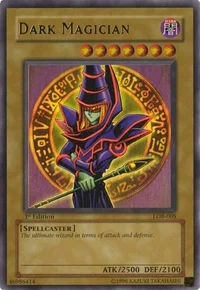
Dark Magician
Dark Magician — LOB-005 1st Edition
Dark Magician from the same LOB print run as Blue-Eyes sits just below it on every grail list. 1st Edition Ultra Rare, PSA 10 population is higher than Blue-Eyes but the nostalgia multiplier is comparable. Sales between $8,000 and $15,000 for PSA 10 copies have been routine through 2024–2025.
Why Dark Magician ranks below Blue-Eyes: Konami printed the Dark Magician in considerably more 1st Edition LOB booster packs than Blue-Eyes (there are multiple distinct Dark Magician print variants from the launch), which has kept PSA 10 population just high enough to cap the ceiling. The Dark Magician archetype page has the full lineage.
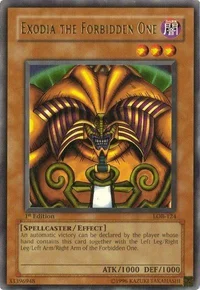
Exodia the Forbidden One
Exodia the Forbidden One — the full set is worth more than any one card
The Exodia the Forbidden One head piece from LOB 1st Edition is a four-figure card on its own. The full five-card Exodia set — head, left arm, right arm, left leg, right leg, all LOB 1st Edition in PSA 10 — has cleared $9,000 in 2024 auctions. The five pieces as a graded matching set carry a premium over their sum because the “complete Exodia” narrative is what collectors are buying.
For single-card collectors, the head piece is the trophy. It’s the only one of the five with iconic standalone art.
Pot of Greed
Shonen Jump Championship Prize Cards — mid-2000s prize pool
Between 2003 and 2009, North American Shonen Jump Championship winners received unique English prize cards — Des Volstgalph, Gold Sarcophagus, Cyber-Stein, Crush Card Virus, Doomcaliber Knight — each printed in runs of 50–200 copies. Graded copies of these prize cards have settled into a consistent $10,000–$20,000 band depending on card and condition.
The 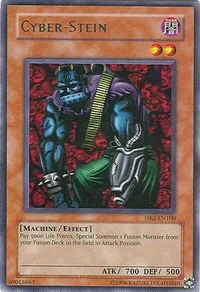 Cyber-Stein Shonen Jump Championship prize version is the most frequently traded of the group and the best starting point for collectors interested in the category. Note the matte finish and the unique SJCS-EN set code that distinguishes prize versions from the mass-produced reprints.
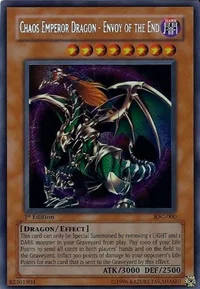
Chaos Emperor Dragon - Envoy of the End
Chaos Emperor Dragon - Envoy of the End
Chaos Emperor Dragon - Envoy of the End in Invasion of Chaos 1st Edition Ultra Rare was the best card in Yu-Gi-Oh! for most of 2003–2005 — banned shortly afterward and still on the Forbidden list two decades later. The IOC 1st Edition print run was modest, PSA 10 population is low, and the card’s role in the game’s early competitive era gives it a permanent grail status.
This is a case study in how Forbidden-list tenure compounds value: a card banned in 2005 and never unbanned accrues more collector demand every year that passes without a reprint resolving the scarcity.
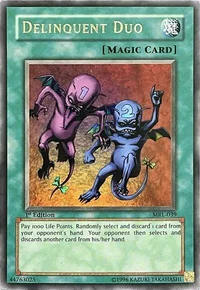
Delinquent Duo
Delinquent Duo — 1st Edition Metal Raiders
Delinquent Duo 1st Edition Ultra Rare from Metal Raiders is a grail for collectors who lived through early-2000s competitive play. The card was staple-good in 2003, was Limited within six months of release, and has been banned since 2005. Metal Raiders had a smaller 1st Edition print run than most LOB-era sets, which is the reason Delinquent Duo graded copies sit above many more-famous MRD cards.
The 1st Edition stamp is the entire value delta here. Unlimited MRD Delinquent Duo in PSA 10 is a sub-$500 card.
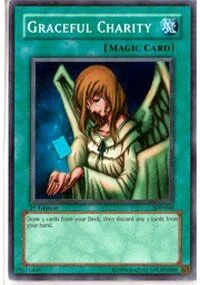
Graceful Charity
Graceful Charity — 1st Edition Pharaoh's Servant
Graceful Charity in 1st Edition Ultra Rare Pharaoh’s Servant is the same pattern as Delinquent Duo: tiny early-2000s print run, immediately banned, never reprinted in a way that resolves the scarcity. PSV Graceful Charity PSA 10s trade in the high three-figure to low four-figure range and have been climbing consistently since 2022.
For collectors: the 1st Edition stamp on PSV is small and easily missed. YuScan’s scanner reads the set code and stamp automatically — one of the reasons we built the app in the first place.
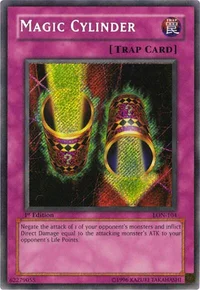
Magic Cylinder
Magic Cylinder — LOB 1st Edition
Magic Cylinder 1st Edition Ultra Rare from LOB shares the LOB 1st Edition nostalgia premium with Blue-Eyes and Dark Magician. Population is higher, demand is lower, but the card is widely recognized and iconic enough to have settled into a consistent $3,000–$4,000 band for PSA 10 copies.
This is the entry point for LOB 1st Edition grail collecting. You will not pay Blue-Eyes money for it and you will still own a true launch-era card.
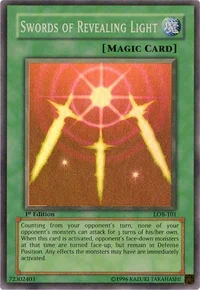
Swords of Revealing Light
Swords of Revealing Light — LOB 1st Ed, Ultra Rare
Swords of Revealing Light completes the LOB 1st Edition Ultra Rare quartet with Blue-Eyes, Dark Magician, and Magic Cylinder. Unlike those three, Swords was Konami’s designated stall card for the first decade of competitive play and saw real tournament use into the late 2000s, which kept PSA 10 population low (most copies were played and edge-worn). Four-figure PSA 10 sales have been routine through 2024–2025.
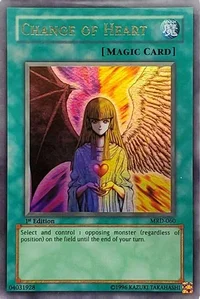
Change of Heart
Change of Heart — LOB 1st Ed
Change of Heart 1st Edition Ultra Rare from LOB, Ultra Rare stamp intact, is another entry-level LOB grail. It has been banned since the mid-2000s, the card is iconic for anyone who watched the original anime, and the LOB print-run premium keeps PSA 10 copies above $2,500.
Worth noting: there are dozens of later reprints of Change of Heart that are worth under $10. The value lives entirely in the LOB-022 set code and the 1st Edition stamp.
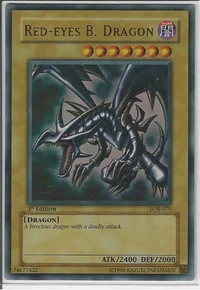
Red-Eyes B. Dragon
Red-Eyes Black Dragon — LOB 1st Edition
Red-Eyes B. Dragon 1st Edition Ultra Rare from LOB closes the list. The card has fewer iconic-moment associations than Blue-Eyes or Dark Magician from the anime, which keeps its price well below those two — but it was part of the same launch print run and shares the structural scarcity. The 2020s Red-Eyes archetype revival via new support has also nudged PSA 10 prices up across the last two years.
On YuScan
Every Yu-Gi-Oh! card, every print
YuScan's card database tracks every printing of every card since 2002 — with per-print pricing and set-code context.
What drives Yu-Gi-Oh! value
Four factors explain nearly every price on this list:
The 2002–2003 launch print run. English LOB 1st Edition, MRD 1st Edition, PSV 1st Edition, and IOC 1st Edition are the rarest early-era print runs. Cards from these sets carry a structural scarcity premium that does not apply to any later reprint.
1st Edition vs Unlimited. The 1st Edition stamp — a small silver mark on the lower-left of the card — is often a 5× to 20× price multiplier for early-era cards. Unlimited prints of the same card in the same rarity are fundamentally different cards in collector terms. YuScan’s 1st Edition vs Unlimited explainer covers the identification details.
Banlist tenure. A card banned for 15+ years accrues collector demand every year without a functional reprint resolving the scarcity. Chaos Emperor Dragon, Delinquent Duo, Graceful Charity, and Change of Heart all share this pattern.
Graded population. PSA 10 (and BGS 9.5+ with matching sub-grades) is the condition tier where grail prices live. A raw copy of LOB 1st Edition Blue-Eyes is worth maybe $2,000–$4,000. A PSA 10 is worth $80,000+. The grading gap is larger in Yu-Gi-Oh! than in almost any other TCG because early-era cards were printed with centering and edge quality that rarely holds up to grading standards.
How to spot a real one
Counterfeit LOB 1st Edition cards exist and are often well-made. The reliable tells are:
- Set code placement and font — LOB-001 through LOB-126, lower-right
- 1st Edition stamp depth and color — silver, slightly embossed, not painted
- Card stock thickness — 2002 Konami stock is marginally thicker than modern
- Holographic layer on Ultra Rares — 2002 holos have a specific coarse pattern distinct from modern foils
If you are considering any purchase above $500, buy graded. PSA, BGS, or CGC authentication closes the fake-card risk almost entirely. YuScan’s fake-spotting guide covers the authentication process in detail.
Scan the cards on this list. Watch the prices move.
YuScan identifies any Yu-Gi-Oh! card in under a second and tracks live prices across TCGPlayer, Cardmarket and eBay per print run — so a 1st Edition and an Unlimited don't get averaged into a meaningless number.
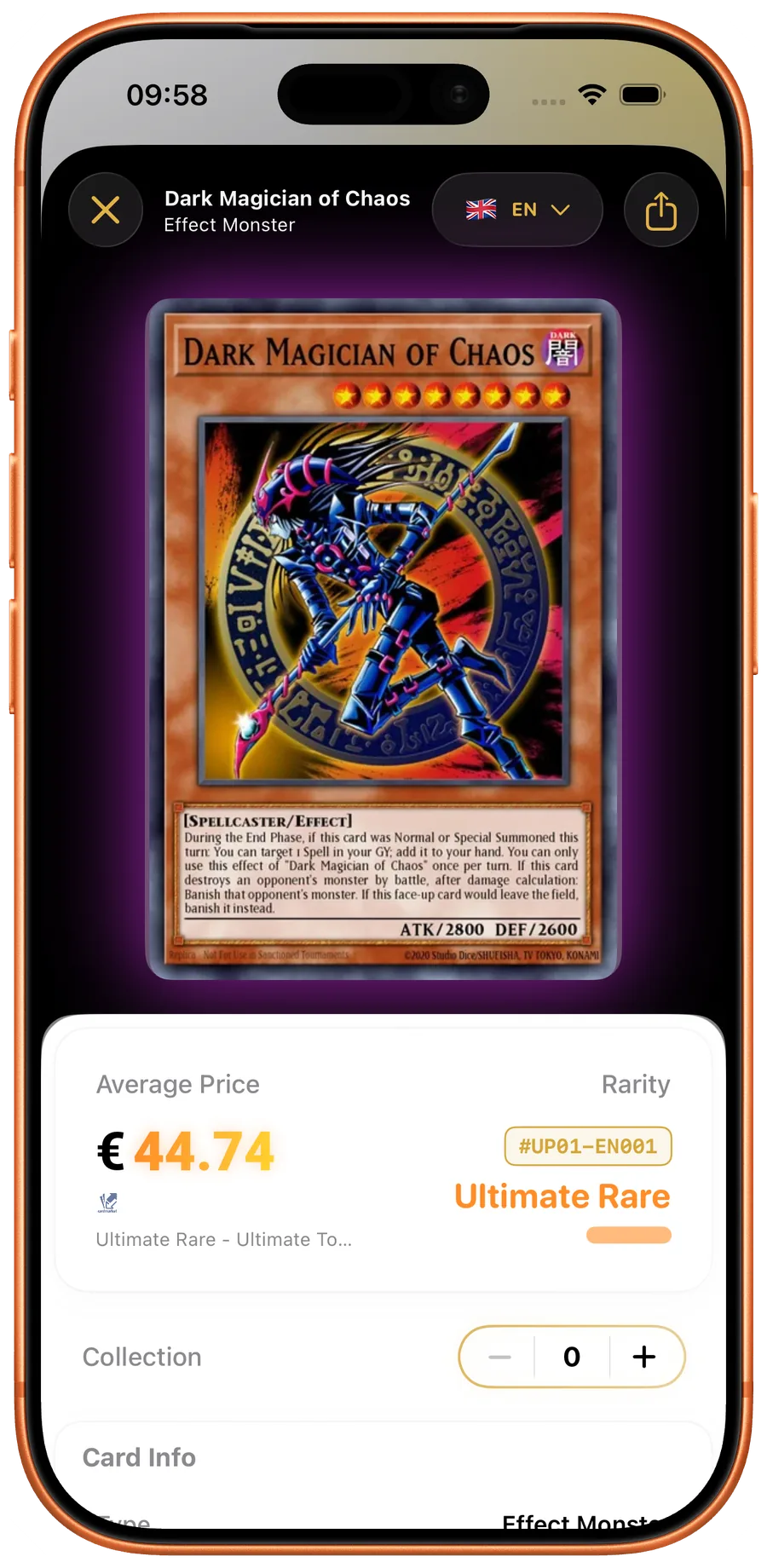
Track the prices above — and every other card in the database — inside YuScan. Prices are updated across TCGPlayer, Cardmarket, and eBay sold-listings per printing, not averaged across print runs. Browse every expansion since LOB to see how print-run context shapes price.